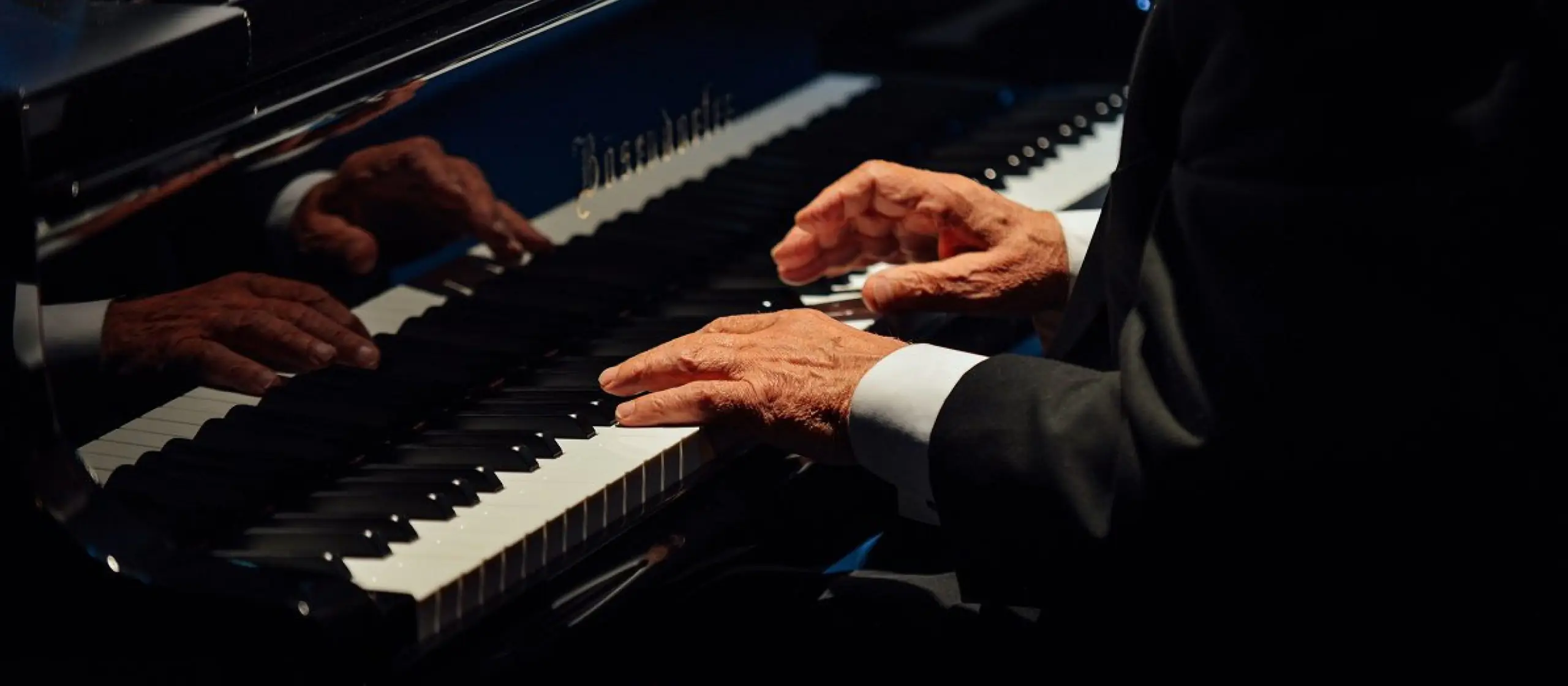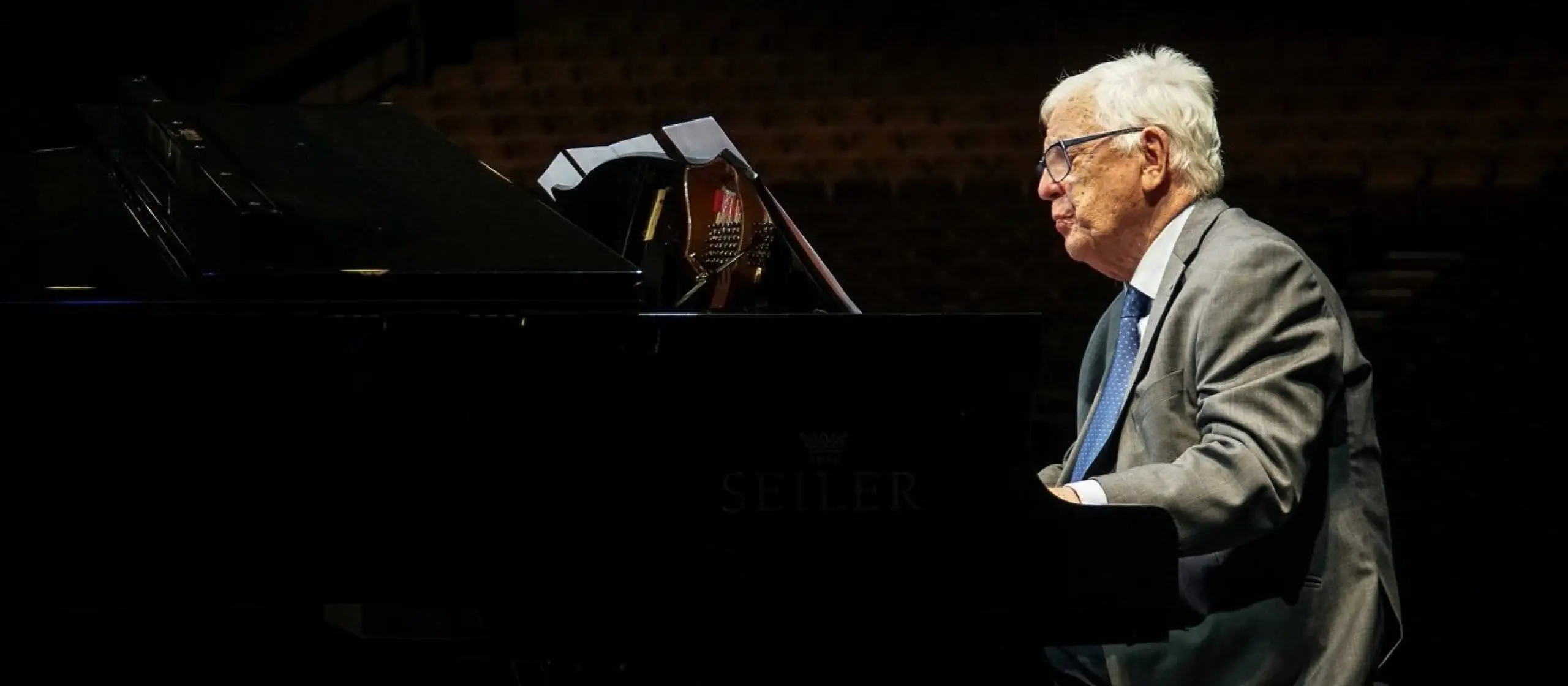
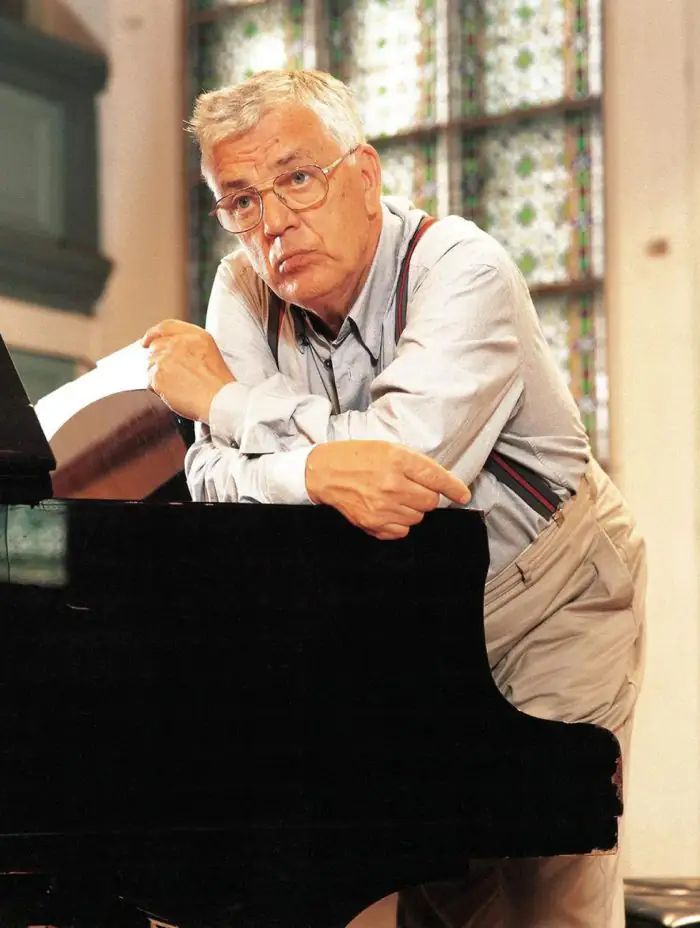
Raimonds Pauls began studying music when he was just over three years old. His first teacher told his father Voldemārs: “This boy will never become a musician—his fingers are far too short.” Thank goodness Voldemārs didn’t listen. Today, the boy with short fingers has eight instrumental compositions, three ballets, ten musicals, scores for 58 films and 56 theatrical productions, and an almost countless number of songs written in collaboration with remarkable people.
Raimonds Pauls & Imants Ziedonis
Imants Ziedonis often said that Raimonds Pauls was one of the few people who could truly “hear” his poems and give them new life in melody.
Pauls has always been able to hear more than just poetry—the composer admitted that while working, he would often imagine the voice that would perform the song. And he imagined it precisely: his music has been sung by some of the most expressive and recognizable voices—Margarita Vilcāne, Ojārs Grīnbergs, Alla Pugacheva, Ance Krauze, Laima Vaikule, Daumants Kalniņš, and many others.
Dziesmiņa par prieku
Un ja nu kādreiz nozākāts
Un triekts un lamāts tieku
Es apsēžos un uzrakstu
Vienu dziesmiņu par prieku
Par prieku sev es uzrakstu
Par savu paša prieku
Un no šīs savas dziesmiņas
Pats priecīgāks es tieku.
<…>
Jo nevajaga nemaz daudz
Kādreiz pavisam nieku
Lai uzrakstītu sev par prieku
Dziesmiņu par prieku.
A Little Song About Joy
And if I ever am insulted
And struck down and cursed
I will sit down and write
A little song about joy.
About my own joy I will write
About my own joy
And from this song of mine
I will myself become happier.
<…>
Because it doesn’t take much
Sometimes just absolutely nothing
To write myself about joy
A little song about joy.
“A Little Song About Joy” is considered the most celebrated work by Raimonds Pauls set to Imants Ziedonis’s words. Particularly moving is the version performed by the maestro himself. Sung by him, this song about light and hope carries even deeper meaning—for there was a time when Raimonds nearly lost that light himself: at a relatively young age, he struggled seriously with alcohol dependency, fought it for a long time—and won. Today he inspires others toward that same victory. For many years now, the maestro has not touched a drop. He says it simply: not drinking means not drinking.
Raimonds Pauls & Guntars Račs
“When I write a text, I already have some melody in mind, some sense of whether it’s a waltz, fast or slow. And then I give it to Raimonds Pauls, who takes all of that and turns it completely upside down! What I thought was a tango becomes a waltz, and the waltz becomes rock and roll. My rhythmic instinct never matched his way of thinking. Which means he is so great that he simply does whatever he wants.”
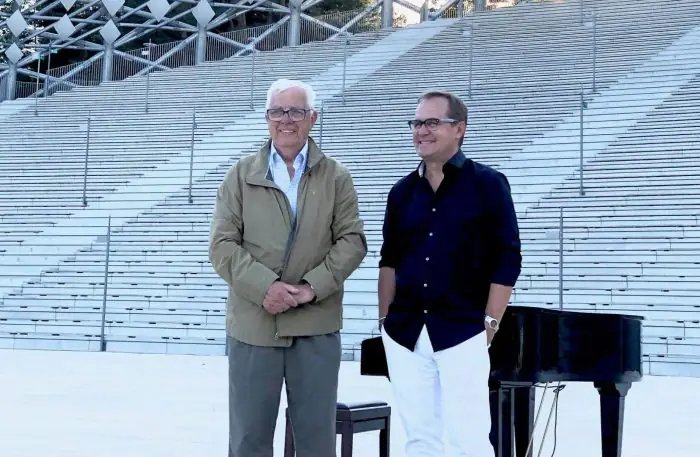
The creative duo of Guntars Račs and Raimonds Pauls is one of the most vibrant examples of successful collaboration in contemporary Latvian pop music. Since the early 2000s, they have written more than a hundred songs together, many of which have already become classics. One of them—written in 2015 for the band bet bet—is the love ode “Summer Will Never End.”
Vasara nebeigsies nakad
Vasara nebeigsies nekad
Saule vienmēr tev to sacīs
Kamēr es mīlēšu tevi
Pasaule ziedēs man acīs.
Saulrieti nebeigsies nekad
Arī ne janvāra salā
Kamēr vien degs mūsu sirdis
Kamēr vēl ceļi nav galā.
Summer Will Never End
Summer will never end
The sun will always tell you that
The world in my eyes will bloom
As long as I love you.
Sunsets will never end
Not even in January’s bitter cold
As long as our hearts burn,
As long as we are still here—on we go.
We don’t know to whom the maestro dedicates this song when he plays it in concert, but most likely—to his wife Svetlana (who, thanks to Raimonds, became Lana to everyone), with whom he shared nearly 61 years of life.

The Latvian Pauls and Odessa-born Svetlana met in Odessa: Pauls had come there for his first major tour; Lana attended the concert on the advice of friends. She later recalled that evening:
“I came into the hall late and at first, in the darkness, I only heard the music. And you know—I first fell in love with those sounds, and only then with Raimonds. I immediately understood that only a person with a very particular soul could speak to an instrument that way.”
After the concert, they met backstage—and there began a romance that lasted 64 years.
Lana passed away on 4 August 2023. That same day, a concert by the maestro was scheduled at the Dzintari Concert Hall. The concert—the most difficult concert of his life—went ahead. Raimonds dedicated it to Lana.
Raimonds often called his wife his shock absorber—the one who could calm his fiery temper.
Ko par laimi sauc
Man jau nekā nevajag, tiešām nekā daudz.
Tikai mazu brīnumu, ko par laimi sauc.
Nevajag man dimantus, tikai Tevi vien.
Mazu vēja brāzmiņu, kas caur matiem skrien.
Tici man, es nevēlos zelta kalnus sev.
Tikai vienu brīdi būt tuvu, tuvu Tev.
Lai jau paliek neatvērts Burgundijas vīns.
Nebūs šodien vajadzīgs baltais limuzīns.
Pietiks man ar vienu vēju un ar diviem mākoņiem.
Dzersim piparmētru tēju, dziedāsim par taureņiem
Pietiks man ar vienu vēju, nevajag man nekā daudz.
Tikai vienu mazu lietu, lietu, ko par laimi sauc.
What Is Called Happiness
I don’t really need anything, truly not much at all
Just a small miracle they call happiness.
I don’t need diamonds, only you alone.
A small gust of wind running through my hair.
Believe me, I don’t wish for the mountains of gold
Just one moment to be close—close to you.
Let the Burgundy wine remain unopened.
We won’t need a white limousine today, believe
One wind and two clouds will be enough for me.
Let’s drink mint tea, let’s sing about butterflies—just you and me.
One wind is enough for me, I don’t need very much
Just one little thing—the small thing they call happiness.
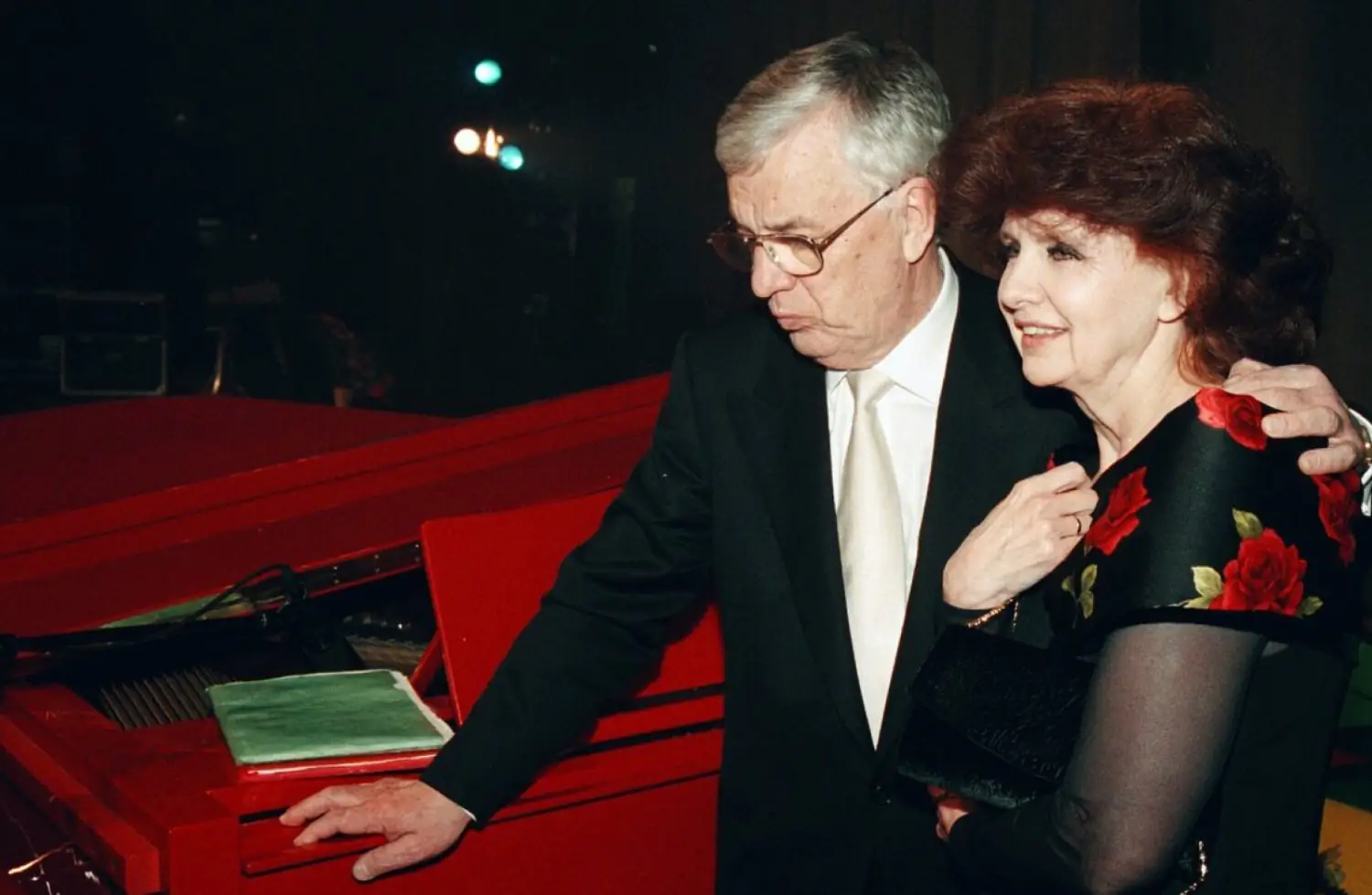
Raimonds Pauls & Māra Zālīte
The great Latvian poet Māra Zālīte and Raimonds Pauls first met in the mid-1990s while working on the musical Meža gulbji. Zālīte wrote the libretto; Pauls composed the music. The musical was a tremendous success—as was their creative partnership.
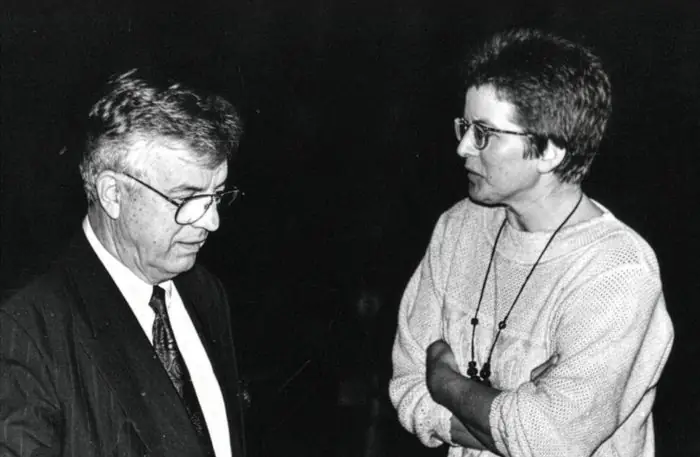
At one point, the poet described Pauls as a “force of nature”—an inseparable part of the Latvian landscape. Whether Pauls considers himself part of that landscape, we don’t know, but he loves the landscape itself more than any other on earth. One of his favorite views and most beloved places is the scenery of Baltezers. He has kept a dacha there for many years, with a small farm—his peasant paradise. Born into a farming family on what was then the edge of the city—in Iļģuciems—he absorbed that strong rural spirit and has carried it with him throughout his life.
“Where you live, you must put things in order.”
Raimonds Pauls’s peasant spirit is above all his extraordinary work ethic. “When you walk out on stage, you must give everything you have inside,” he has said. And he always did.
His capacity for work extends far beyond the stage. Even after achieving international fame, Pauls retained that same peasant simplicity: he never shied away from physical work. Until recently, he handled most household tasks himself—from mowing the lawn to minor repairs and electrical work.
Kamēr svecītes deg
Kamēr svecītes deg
Kamēr liesmiņas plīvo
Kamēr mēs visi šeit
Visu tu vari gūt
Kamēr svecītes deg
Kamēr vien esi dzīvs
Viss tu vēl vari būt
Vēlies tikai vēlies!
To var ikviens
To var ikdien, ikdien
Kamēr nezin neviens, klusi, lai nedzird neviens
Stipri tā kā neviens nevar neviens, neviens,
Neviens aizkavēt to
Vēlies, vēlies, kaut ko vēlies…
While the Candles Are Burning
While the candles are burning,
While the little flames are dancing,
While we are all here,
You can gain anything, my friend.
While the candles are burning,
While you are still alive,
You can still become anything –
Just wish, just wish.
Anyone can do it,
Anyone can, every day, every day.
So while no one knows,
Quietly, so no one can hear,
And strongly, as no one else can stop it
Wish, wish…please wish for something.
Raimonds Pauls & Jānis Pēters
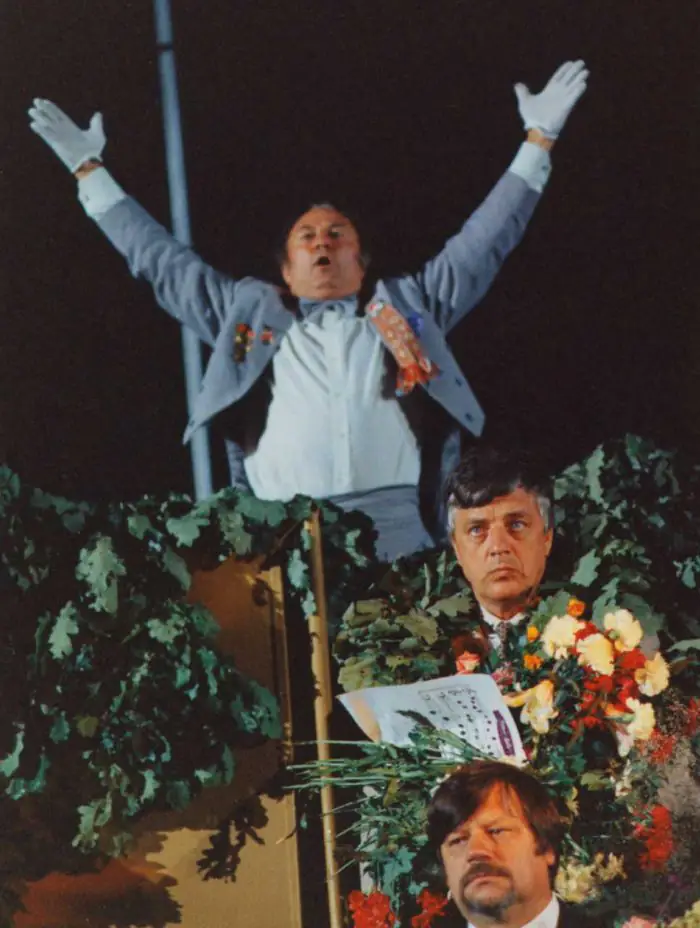
Raimonds Pauls has admitted more than once that he has no close friends. But Jānis Pēters is a rare exception.
They met in the late 1960s, and by 1971 had begun working together creatively—a collaboration that continued without interruption until the poet’s death in 2025.
The maestro said that Pēters was one of the brightest people he had ever encountered. Perhaps that is why their partnership was so natural: Pēters set clear, light-filled lyrics to Pauls’s melodic, slightly sentimental music—lyrics that instantly resonated with listeners.
Pēters once recalled:
“One time we were sitting together… and I said that Pauls writes music that is too sentimental. He swallowed his reply, saying nothing. Soon after, he came to my home and said: ‘Well, then write it yourself if you’re so clever.’ And that’s how we started working together.”
In this description of a close friend—the whole character of Pauls: direct and honest. And a man of few words. But that is only in life—in music, he has always been and remains very open. “He can be silent for a long time, doing nothing, and then he’ll walk up to the piano—and the music says everything,” his other close friend Alla Pugacheva once said. We hope the maestro’s music still has much more to tell us.

Te viss ir tavs
Te viss ir tavs –
Gan nakts, gan rīts, gan saules lēkts.
<…>
Paskaties mēnesī, zvaigžņotā debesī tu,
Pasaules skaistāko dzīvības svečturi tur.
Te viss ir tavs – pasaule,
Gan nakts, gan rīts, gan saules lēkts,
Saules lēkts.
Zied gaiss un tu dziedi ar to,
Zūd laiks un es dzīvībā glābjos
Kur viss ir sen apsolīts tev –
Gan nakts, gan rīts, gan saules lēkts,
Gan nakts, gan rīts, gan saules lēkts.
Here, Everything Is Yours
Here everything is yours —
The night, the morning, the sunrise.
<…>
Look at the moon, at the star-filled sky –
There hangs the world’s most beautiful candle of life.
Here everything is yours – the world,
The night, the morning, the sunrise,
The sunrise.
The air is blooming, and you are singing along.
Time fades away, and I take refuge in life
Where everything has long been promised just to you —
The night, the morning, the sunrise,
The night, the morning, the sunrise.