According to one version, it was Rīdzene that gave the name to the future city. And although the river itself has long disappeared from the map, without it Riga’s history could have turned out completely differently.
Riga’s first harbor
The name of the river first appears in documents of 1297 in the Latin forms Riga rivus and Riga flumen. However, its history began much earlier. Already in the 11th–12th centuries, the Daugava Livs and settlers from Northern Kurzeme lived on the banks of Rīdzene. Land and water trade routes crossed here, and the river itself flowed into the Daugava, connecting the interior regions with the region’s main trade route.
Rīdzene was not a stream but a fully navigable river. Before flowing into the Daugava, its width reached 50–55 meters, and its depth was about four meters. A wide bend formed a natural harbor where ships could safely stop, unload goods and wait out bad weather.
According to the Museum of the History of Riga and Navigation, already in the second half of the 12th century, the settlement at Rīdzene became one of the important trade centers of the lower Daugava. Along the banks, for almost a kilometer, stretched wooden fortifications that protected the city from the water. Here were piers and warehouses where German merchant ships moored, as well as vessels heading to the bishop’s court and the castle of the Order of the Sword Brothers.
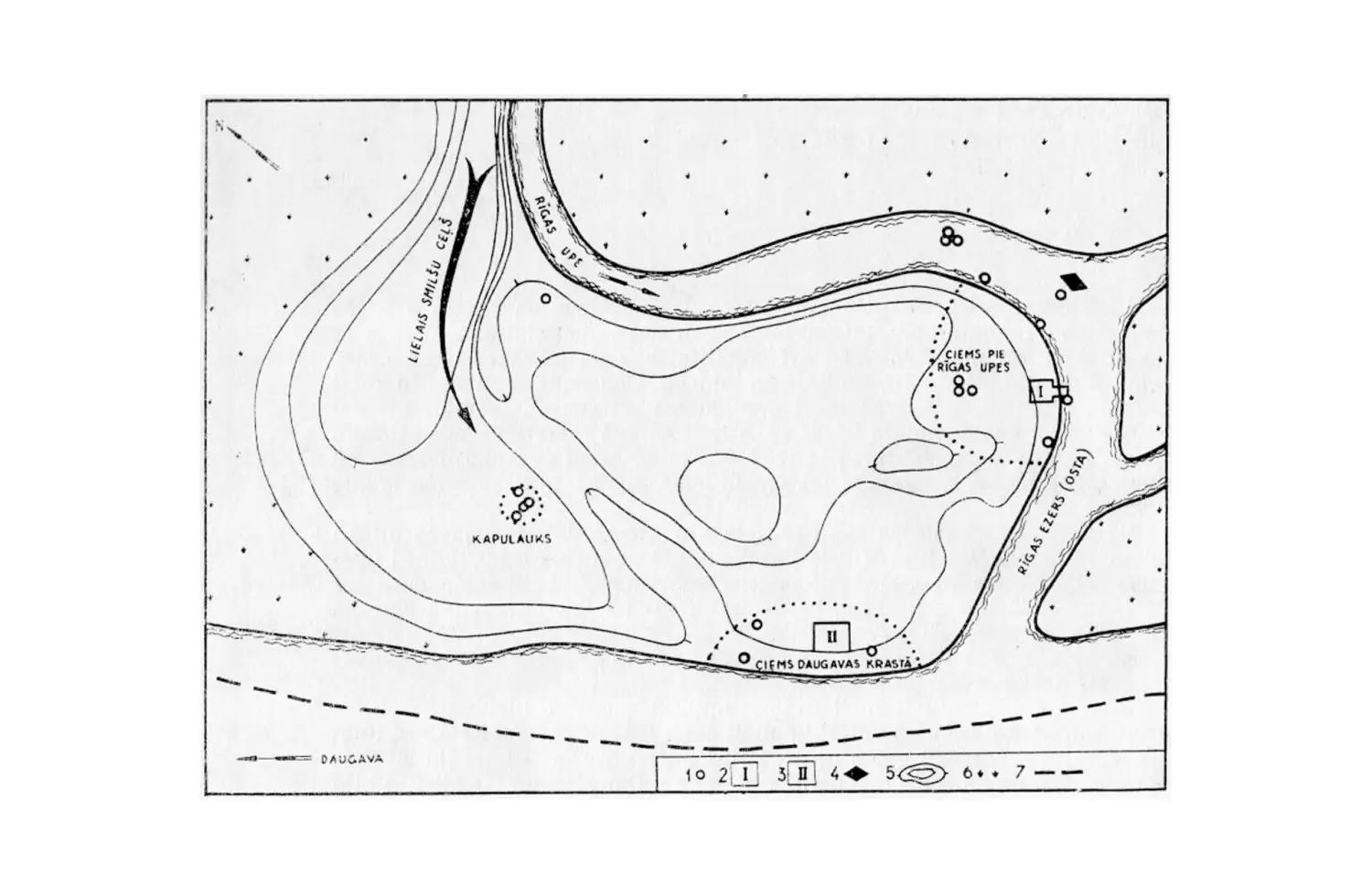
Which streets did Rīdzene flow along
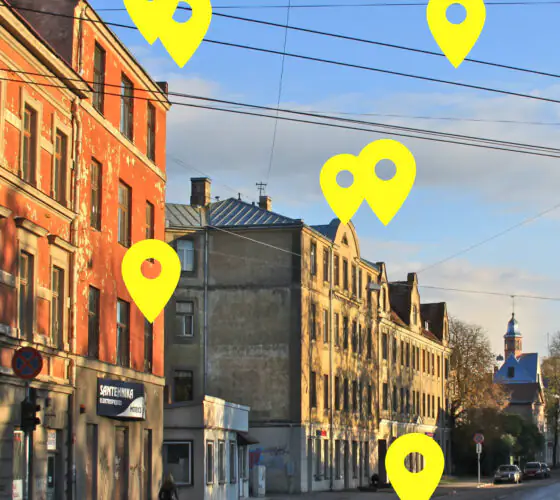
The presumed route of Rīdzene is associated with today’s streets—Meistaru, Kalēju, Teātra, Riharda Vāgnera, Audēju, Rīdzenes, Vaļņu and 13. janvāra.
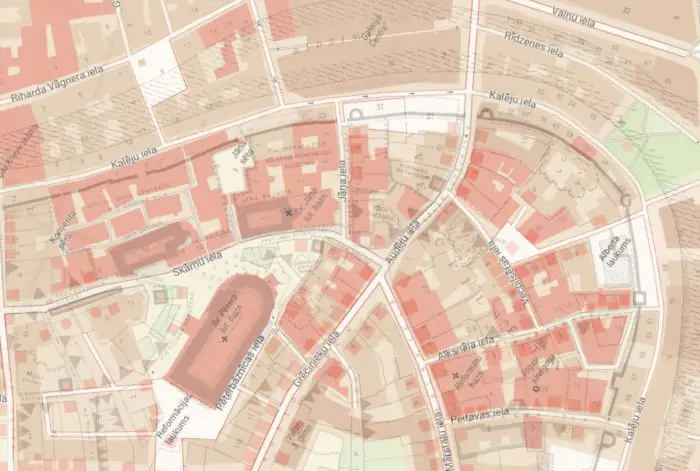
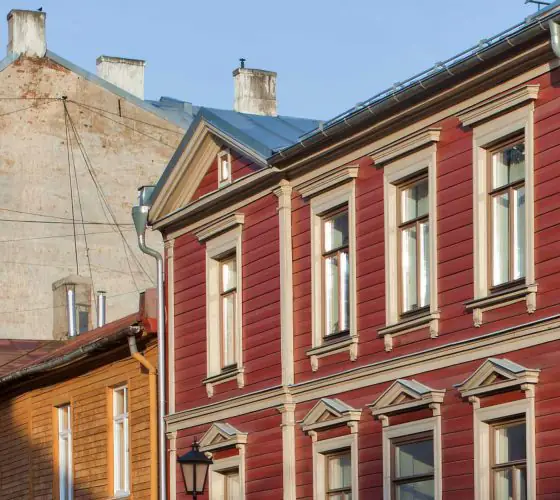
Of course, this does not mean that the river ran strictly down the center of each of these streets. Over the centuries, the shoreline changed repeatedly, the channel gradually narrowed, and new land areas were created artificially. Nevertheless, the layout of Old Riga still largely follows the contours of the historical landscape.
The most obvious reminder of the river remains Rīdzenes iela. Today it is a small pedestrian street in the center of Old Riga, but its name preserves the memory of the river with which the city’s history began.
Why did Rīdzene disappear
The city quite literally advanced onto the river. As Riga grew, its banks were reinforced with wooden structures, and the space between the old and new banks was gradually filled in with earth, household waste, and construction debris. Thus, step by step, the city reclaimed territory from the water. Where piers and boats once stood, houses and streets eventually appeared.
Paradoxically, one of the reasons for the first harbor’s decline was the very success of trade itself. Already in the 13th–14th centuries, vessels grew larger and increasingly moored directly along the banks of the Daugava. For large ships, Rīdzene gradually proved too narrow and shallow.
At the same time, the center of urban life shifted closer to the Daugava. Here arose the cathedral, the bishop’s court, and later—the castle of the Livonian Order. The old harbor gradually lost its importance.
The townspeople themselves also played a role. The river was used for waste disposal, the channel silted up, and the current slowed. For several more centuries, Rīdzene served small barges and flat-bottomed boats, but by the beginning of the 18th century, written mentions of navigation practically disappear.
Over several centuries, the width of the channel in its widest part shrank from 50–55 meters to just one to one and a half meters. At first, the remaining channel was left open, then it was enclosed in a wooden structure and completely covered over.
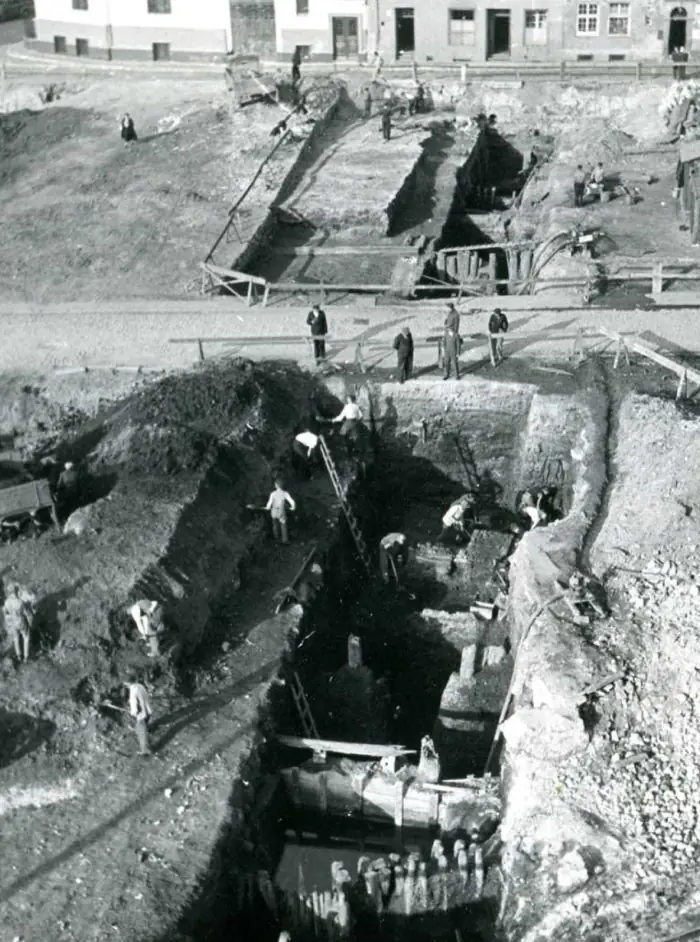
What archaeologists find
Although the river itself has disappeared from the city’s surface, it continues to tell its story to archaeologists.
Research into the former bed of Rīdzene has shown that beneath the streets of Old Riga, traces of a true port city have been preserved—wooden piles, reinforced banks, remnants of piers, and ancient hydraulic engineering structures.
On Kalēju iela and 13. janvāra iela, archaeologists have uncovered wooden structures that once reinforced the riverbanks. In 1970, the remains of a structure were found that researchers believe to be an ancient pier. Two rows of piles extended from the natural bank toward the water. It is assumed that this pier was used by residents of a nearby Liv settlement as early as the 12th century.
Today, such structures have been found in at least eleven locations in Old Riga.
Among the most famous finds are three vessels discovered in the former bed of Rīdzene—in 1554, 1938, and 1939. Particularly valuable is the hull of a 13th-century ship that sank in the ancient harbor. Today, it is kept in the Museum of the History of Riga and Navigation.
Thanks to these finds, Rīdzene ceases to be an abstract line on an old map and turns into a real port—where wooden ships once arrived with goods and passengers.
Has the river remained beneath the modern city
In 2004, during the construction of a building at Teātra iela 2/4, archaeologists discovered the remains of a covered wooden channel of Rīdzene and the foundations of previously unknown structures. The find once again confirmed—modern Riga literally stands on the site of the ancient river.
The former riverbed still remains part of the underground geography of Old Riga. This is precisely why any construction work here requires special attention to cultural layers, ancient wooden structures, soil conditions, and groundwater levels. The Old Town is a protected archaeological monument and is included in the UNESCO World Heritage list.
Over eight centuries, the street level in some parts of Old Riga has risen by four to six meters. During excavations, archaeologists literally descend several stories downward. Beneath the modern pavement lie ancient banks, piers, house foundations, wooden decking, and the former bed of Rīdzene.
Wooden piles, parts of wharves, and even medieval ships have been preserved thanks to the waterlogged soil. The bottom of the ancient harbor today lies approximately five to six meters below the level of modern streets.
Rīdzene today
In the Middle Ages, Rīdzene was one of the city’s main transport arteries. Today, its route has become part of the urban fabric. In place of piers came streets and squares, and on the sites of warehouses and port facilities grew residential buildings, hotels, restaurants, and shops. Walking along Meistaru, Kalēju, Teātra, Audēju, Rīdzenes, Vaļņu or 13. janvāra, residents and visitors to the city rarely think that they are walking along the former banks of a river. Yet it was here that the harbor once stood—where Riga’s history began.
Rīdzene has disappeared from the map, but not from the city’s memory. Its name lives on in Rīdzenes iela, the Radisson Blu Rīdzene hotel, the Rīdzene Bar & Library restaurant, the Riga Rīdzene Rotary Club, and museum exhibits.
Today the river can no longer be seen, but its traces are still hidden beneath the pavement of Old Riga. And every time you walk along these streets, it is worth remembering—beneath the stone and asphalt, water once lapped, and on its banks a city grew.